
Over the years, IKEA has become a favoured furniture brand for an impressively wide customer base, from college students acquiring their requisite first futon to long-time homeowners who need a new bookcase or crib.
Through its broad outreach, IKEA demonstrates how its marketing strategy supports a wide array of customer needs, ensuring customer satisfaction remains high.
Quality products, affordable prices and a do-it-yourself assembly attitude are big reasons for IKEA’s success. Plus, it doesn’t hurt that the company’s marketing strategy is second to none.
The IKEA effect — in which customers feel more connected to items they build themselves — plays a major role in the brand’s marketing, enhancing customer loyalty through active participation.
What Makes IKEA’s Marketing So Successful?
IKEA’s brand identity ranks among some of the most iconic logos, campaigns and companies in recent history. Just like Coca-Cola has its signature colours and script, there’s hardly any mistaking IKEA’s bold lettering or its blue and yellow themes. Like Apple, every retail store offers exciting customer experiences from the moment you spot their unmistakable facades on the horizon.
By emphasising its commitment to consistency and design, IKEA promotes strong brand loyalty that is an integral part of its marketing plan. Who would have thought we’d get so excited about the prospect of hauling home a few flat boxes and whipping out a hex key to build our own furniture?
IKEA’s marketing strategy is so successful because it’s original, distinctive and imaginative while also maintaining a clear value proposition. This blend of creativity and clarity reflects an effective marketing strategy, one that supports growing marketing hub opportunities and positions IKEA as a leading furniture retailer.
If I told you I owned a LAIVA bookcase, then chances are, without even being able to picture the item, you’d know:
- It comes from the Nordic furniture company IKEA.
- It didn’t break my budget.
- It was easy to transport home.
- After I got it back to my apartment, I put it together myself.
- It probably boasts a chic, modern style.
- I’m going to keep talking about how much I love it to everybody I know.
That’s the power of IKEA’s marketing mix. This strong sense of brand identity aligns well with search engine optimization, especially when customers and potential buyers start looking for “affordable furniture” or discover IKEA’s digital marketing strategy online.
What Marketing Strategies Does IKEA Use?
Each element of IKEA’s outreach strategy is carefully curated to support its brand identity and to create memorable customer experiences:
- The company employs a consistent and easily recognisable theme, from its product names to its color scheme.
- Mixed-and-matched products are available to suit each customer’s unique style and needs.
- Product offerings walk the fine line between mass-market affordability and reusable durability.
- Sponsored content with creative partners expands the brand’s appeal to new demographics.
- All sale items are displayed in a way that’s designed to inspire the customer’s vision.
- The brand is participatory, and people are encouraged to take IKEA ideas and run with them.
- IKEA leverages the latest technology to provide cutting-edge experiences consistent with its ethos. This includes social media marketing and exploring emerging channels like WhatsApp marketing to drive additional customer engagement through key social media platforms.
Let’s explore each of these points in greater detail.
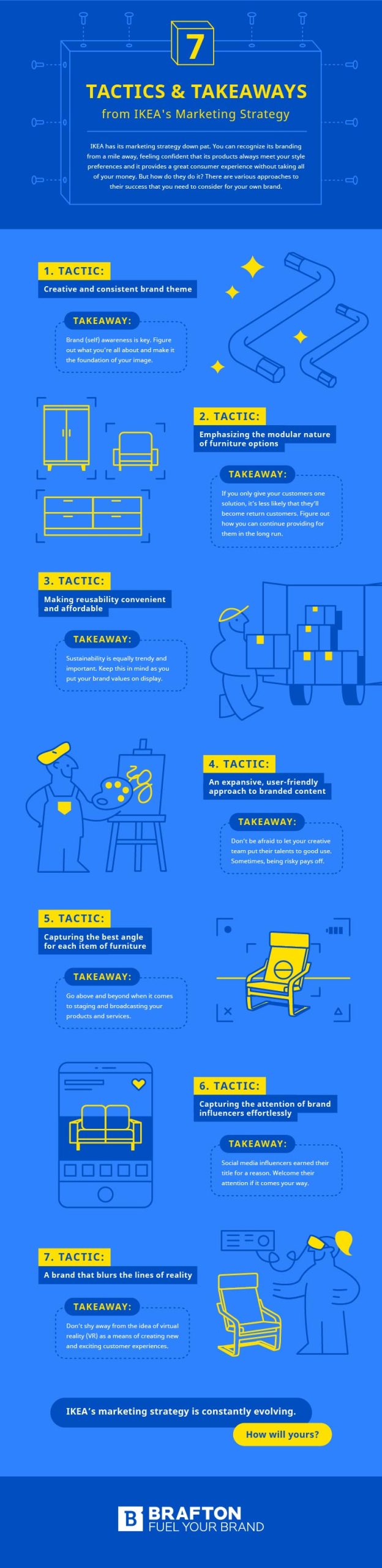
Tactic No. 1: A Creative, Consistent Brand Theme
Imagine a world in which IKEA’s Australian stores are draped in green and gold. They just serve hot roasted lamb in the cafeteria, and every forgettable furniture name fades into all the others.
Ho-hum.
Don’t blend in. It’s better to wear your roots proudly!
From the Swedish national colors emblazoned on its buildings to the sensational meatballs served in its store cafeterias, IKEA proudly sports its cultural heritage. Acknowledging its origins allows the IKEA group to remain rooted while marketing globally, building trust through authenticity and customer service.
The Takeaway: Know Thyself
Tongue-in-cheek isn’t the only way to own your brand. It’s just important to figure out what you’re about and to infuse all elements of your identity with a strong sense of self-assuredness. In doing this, you’ll have imbued your brand with an authenticity that appeals to your target audience — and beyond — as more bystanders become intrigued.
Social media can be a great place to start implementing that creative consistency. Through a solid digital marketing strategy on relevant social media platforms, brands can reinforce their core identity and reach new demographics more effectively.
Subscribe to
The Content Marketer
Get weekly insights, advice and opinions about all things digital marketing.
Thanks for subscribing! Keep an eye out for a Welcome email from us shortly. If you don’t see it come through, check your spam folder and mark the email as “not spam.”
Tactic No. 2: Emphasising the Modular Nature of Home Furniture Options
Not every market is blessed with the ability to allow for a seemingly endless assortment of customer choices. But a simple tiered strategy doesn’t give your brand many opportunities for encouraging repeat business. If your customers already feel that they’ve invested in the latest and greatest, then they don’t have much incentive to come back for more until their original purchase is broken or depleted.
IKEA encourages flexibility, customization and mix-and-match furniture modules. The combination of affordability and sustainability is key to this success. This approach forms the backbone of IKEA’s marketing strategy, as it simultaneously promotes affordable price points and design flexibility, thus boosting customer loyalty.
After you meander through IKEA’s dazzling showrooms, remember that you’re basically ejected into a warehouse. Outsourcing some of the logistics and assembly to consumers helps the company streamline its supply chain and reduce prices for the end user.
Putting together an IKEA product for yourself helps free the business up to focus on its own sustainability initiatives. By showing unwavering commitment to being eco-friendly, the IKEA brand also differentiates itself from other furniture retailer competitors in the market.
The Takeaway: Give Your Customers a Reason To Explore Their Options
Right now, if you only provide one right answer for your customer, focus on finding out how you can help them create their own original response instead.
While the Swedish furniture giant encourages any customer to get creative with their IKEA products, the approach may look different for you. In certain industries, offering flexible options and encouraging user creativity can be a powerful marketing plan, promoting repeat visits and brand advocacy.
Tactic No. 3: Making Reusability Convenient and Affordable
In an era of planned obsolescence, it may seem counterintuitive for a furniture company to emphasise reusability. To be fair, the key points of the IKEA brand value proposition that we mentioned earlier don’t necessarily lead with a guarantee that every product will last a lifetime. But this company is far from disposable.
It’s likely that you’ve seen the iconic FRAKTA bag out in the wild at some point, perhaps even being used in lieu of a leash on mass transit. This example underscores the IKEA effect once again, in which customers become active participants in bringing this powerful brand into their everyday lives.
While the beds and desks you’ll find at IKEA aren’t handcrafted by experts who pledge a lifelong guarantee tethered to their personal honour, the company still provides its customers with products that are built to last. Even IKEA’s durable, reusable shopping bags stand as a testament to the company’s commitment to sustainability.
The Takeaway: Give Them Something (Reusable) To Talk About
Customer behaviour has long been shifting toward one that puts eco-friendliness and environmental awareness above all — but sustainability goes beyond that. Make sure that your brand is showcasing these values and placing them on display through long-lasting products that are built with a sustainable purpose in mind. This can lead to improved customer service ratings and a more meaningful shopping experience.
Tactic No. 4: An Expansive, User-Friendly Approach to Branded Content
Today’s average TikTok video boasts production values that would put even some professional-grade web series from the late 2000s to shame. That said, the IKEA-sponsored comedic series “Easy to Assemble” was a bold, odd, irreverent and ambitious undertaking that featured talented celebrities like Illeana Douglas, Jeff Goldblum, Jane Lynch and others.
This innovative content marketing was far from a furniture product demo, but the IKEA branding was everywhere.
Sometimes it pays to give creatives free rein over the project.
After all, when has it ever felt natural to sponsor a series and then casually work the featured product into the storyline for some tight close-ups of the logo? Why not just plaster the brand everywhere and let your target consumers enjoy some quality, original content?
The Takeaway: Be Adventurous
Don’t be afraid to take new steps into the wild, weird and unknown. Just like this IKEA marketing strategy, it’ll get people talking on social media — especially if you partner with Illeana Douglas. By tapping into bold mediums, IKEA’s marketing fosters customer engagement and can even be integrated into a broader digital marketing course curriculum as a best-practice case study.
Tactic No. 5: Capturing the Best Angle for Each Item of Furniture
IKEA’s classic catalogues have been a brand fixture for a long time. Carefully staging each product to inspire the viewer is something that this business does exceptionally well. Even inside IKEA stores, customers wind through elaborate room-based displays to imagine how they could best put each item to use.
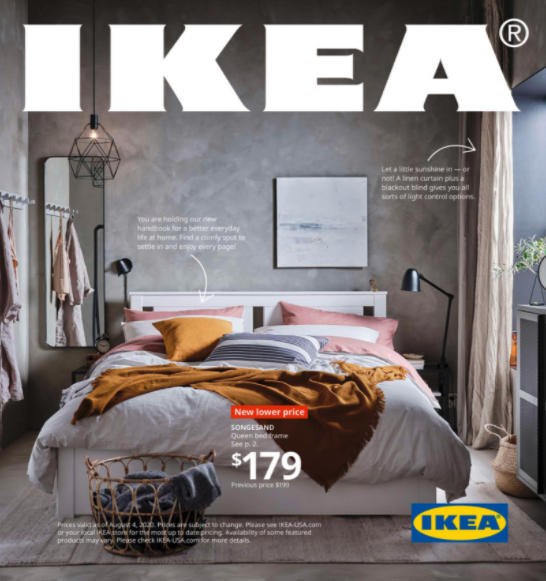
There’s an unstated but unmistakable aspirational component to this publication, too. IKEA masterfully connects with its market base to evoke ideal living spaces tastefully facilitated by the company’s products. The IKEA catalog integrates seamlessly with the rest of IKEA’s digital marketing strategy, ensuring that both physical and virtual browsing experiences spark curiosity and conversions.
The Takeaway: Don’t Skimp on the Staging
It takes more than just perfect lighting or the right angle to make your products stand out. Just as an IKEA store frames IKEA furniture in a way that inspires, let your products sparkle in the same way by putting each in a larger context for your audience. This will no doubt facilitate a better customer experience, too.
Tactic No. 6: Capturing the Attention of Brand Influencers Effortlessly
Furniture companies may not be lifestyle brands, but they still seek a strong sense of loyalty from their customers, new and old. For IKEA, that goes doubly, considering the powerful, unique brand image it has developed over the years.
Sponsored digital marketing campaigns have their uses, but organic influencer appeal may just be the way forward for increasingly sceptical millennials, not to mention the socially savvy contingent known as Gen Z. Nothing can replace a genuine social media connection. Leveraging social media marketing techniques across social media platforms empowers IKEA’s success in sustaining a dialogue with new audiences.
The Takeaway: Stay Open to Outside Influencers
If you’re confident in your brand and your product, be ready and welcoming for attention from social media influencers. These talented individuals, whether they know it or not, are digital marketing savants — offering a sub-platform with an already-engaged audience that can help you reach more customers in your target market. By maintaining openness and authenticity, your brand may organically become part of influential discussions, fueling growth marketing.
Tactic No. 7: A Brand That Blurs the Lines of Reality
IKEA realised that emerging technologies can help encourage customers to become home decor visionaries. No longer do you have to simply imagine whether a certain piece of furniture would match your given aesthetic. Now you can see it.
The IKEA Place app uses augmented reality (AR) to give customers a real view of how items will fit into their living space. Such a tool combines project management acumen with a forward-thinking approach to the digital marketing strategy, offering a truly immersive shopping experience for consumers.
This is a new evolution in an exciting lineage. IKEA has always used digital tools to help customers picture how products will fit, or if they’ll fit, into their lives.
The Takeaway: Think of New and Creative Ways To Use AR and VR
As AR and virtual reality (VR) become more sophisticated and widely available, savvy marketers will explore new options for facilitating exciting new customer experiences. And because marketers (and consumers) are still getting used to these kinds of exciting technological implementations, brands that take advantage of them now stand to gain a competitive advantage over their adversaries. From WhatsApp marketing possibilities to advanced VR demos, there is a range of unexplored territory for search engine optimization and marketing hub innovation.
IKEA: Swedish for Innovative Furniture Marketing
OK, maybe that’s not a literal translation. That said, this company has pioneered some truly original marketing strategies over the years. And we can’t wait to see how the brand evolves in the future. Whether it’s IKEA’s commitment to creativity, an emphasis on pricing strategy, or a marketing plan built around customer loyalty, there’s a lot to learn and apply to your own brand’s effective marketing strategy.
Editor’s Note: Updated May 2025.